
Caring for a Bedridden Person at Home
Between Boundless Love and Physical Limits
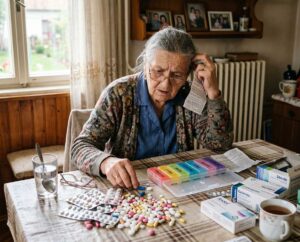
The decision to care for a bedridden parent in your own home is an act of the deepest respect and love. The desire to give back even a fraction of the care they once gave you while you were growing up is noble. However, the reality of 24-hour care often goes far beyond what the heart prepares us for. It is a marathon with no finish line, running every second of every minute, without weekends or holidays.
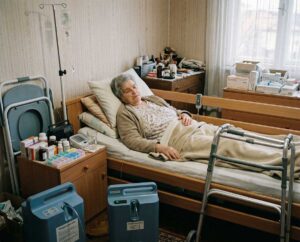
When a parent becomes dependent on others for every need, even the smallest one, from taking a sip of water to changing body position, your home stops being just a living space. It turns into a small, improvised hospital. To fulfill this role with dignity, without endangering either their health or your own, it is essential to understand the harsh physiology of immobility.
What Happens to a Body That Doesn’t Move
Prolonged lying down is not simply “rest.” For a human body designed for movement, immobility is an aggressive state. In bedridden individuals, every organ system suffers:
- Circulation slows down: Blood struggles to return from the legs to the heart, increasing the risk of thrombosis.
- Lungs become “inactive”: The lower parts of the lungs do not expand properly, fluid accumulates more easily, creating a high risk of hypostatic pneumonia, often fatal in older patients.
- Muscles and joints deteriorate: After just a few days of complete immobility, muscles lose mass, and joints begin to stiffen (contractures), causing pain even with minimal movement.
Practical Daily Care Tips: More Than Basic Hygiene
Caring for a bedridden person is a complex process of preserving skin integrity and organ function. It requires discipline and medical precision.
1. The “Two-Hour Rule”: The Key to Survival
The biggest enemy of bedridden patients is constant pressure on the same areas, typically the heels, sacral region (tailbone), shoulder blades, and elbows. In these areas, capillaries close under body weight, tissue stops receiving oxygen, and begins to die.
What to do:
The patient must be repositioned every two hours. If lying on their back, the next position should be the left side, then the right side. Use pillows and supports to relieve pressure from critical points. Never leave a person in the same position overnight.
2. Hydration and Nutrition: Internal Skin Protection
Even if the patient does not feel thirst, which is common in older individuals due to a weakened thirst mechanism, regular fluid intake is essential. Dehydrated skin loses elasticity and cracks easily.
What to do:
Offer water, tea, or natural juices every hour in small sips. Nutrition must be rich in protein, as it is the building material for the skin. Without sufficient protein, wounds cannot heal.
3. Hygiene Without Drying the Skin: Preserving the Barrier
Washing with soap and water can be counterproductive in bedridden patients, as it removes the natural oils that protect the skin.
What to do:
Use no-rinse cleansing foams. In areas exposed to moisture (due to diapers), apply zinc-based creams that create a protective barrier. The skin must always be dry, but nourished.
4. Passive Exercise: Preventing Stiffness
Even if the person cannot move their limbs, you can move them for them.
What to do:
At least twice a day, gently bend and extend the joints. This stimulates circulation and prevents tendon shortening. It is crucial for preventing chronic pain caused by stiffness.
Pressure Ulcers: The Silent Enemy That Punishes Mistakes
The greatest fear of any caregiver is pressure ulcers (bedsores). They are deceptive. They often begin as mild redness that does not disappear even after repositioning. This is the first stage and the last moment when you can intervene independently.
In home conditions, where it is nearly impossible to ensure ideal hygiene and provide a high-quality medical bed with an anti-decubitus mattress, these wounds can progress alarmingly fast. Within just a few days, simple redness can develop into deep wounds affecting muscles and even bone.
Once a pressure ulcer develops, it is no longer just a cosmetic or hygiene issue. It becomes a source of infection, causes severe pain, and often requires surgical intervention. This is the breaking point where families realize that expert palliative care is not a luxury, but a necessity.
Caregiver Burnout: When Strength Runs Out
Caring for a bedridden person is one of the most physically demanding jobs imaginable. It involves constant lifting, turning, and dressing an adult who cannot assist with their own weight. This almost inevitably leads to back injuries, joint problems, and chronic exhaustion.
However, the psychological burden is what truly breaks you:
- Constant alertness
- Sleep deprivation due to repositioning every two hours
- Emotional pain of watching a once-independent parent lose basic abilities
It is important to understand: admitting that you can no longer manage alone is not betrayal or failure. It is responsibility.
At a certain point, your parent needs professional care, trained medical staff who can detect the earliest changes in skin condition, and an environment capable of responding to emergencies 24/7.

Transition to a Nursing Home: Safety First
The moment you feel that the situation is slipping out of control, whether due to the appearance of wounds, worsening illness, breathing complications, or your own exhaustion, transitioning to a care facility becomes a life-saving decision for both you and your parent.
At Vila Košuta, we specialize in the most demanding patient categories. Our team of doctors and nurses applies advanced pressure ulcer prevention techniques, uses modern wound dressings that accelerate tissue regeneration, and follows protocols designed for maximum comfort of bedridden individuals.
Here, your parent receives professional care, but also something equally important: social presence. Even if immobile, our residents remain part of a community. We ensure that their room is not their entire world.
Your parent gains medical security, and you regain your role as a daughter or son. You no longer visit with anxiety about wounds or hygiene, but with peace of mind, ready to spend meaningful time together.
How to Safely Transport a Bedridden Person
Many families delay this decision due to fear of logistics. How do you move a bedridden person from a third-floor apartment? How do you transport them safely through city traffic?
This should not be your concern.
Professional medical transport services handle this, using specialized vehicles equipped as mobile care units, with trained staff who know how to move patients safely and without pain. They transfer your parent directly from their bed at home to a bed in the facility, with full medical supervision.
You Are Not Alone
Caring for a bedridden person is a marathon, not a sprint. No one can run a marathon forever without rest.
If you feel physically and emotionally exhausted, that is not weakness, it is human.
Allow professionals to take over the medical and technical burden, while you preserve what matters most, your love and emotional support.
At Vila Košuta, our doors are always open. You are welcome to visit, have a conversation, and see how we care for our patients. Experience the hygiene, speak with our nurses, and feel the peace that comes from a licensed and professionally managed institution.
Dignity in old age has no alternative, and your peace of mind is the foundation for being the best version of yourself for your parent.
We are here to find the best solution for your family’s peace of mind and your parent’s dignified life.